

Anyone who still relies on traditional methods of information classification today is wasting time – and, in the worst case, losing customers. Modern AI systems make all the difference: they analyze even unstructured document types in seconds, learn with every training session, and deliver accurate results without any complicated setup.
This is the decisive lever for not only keeping pace in information management, but also clearly outperforming the competition. In this article, we show you how this can be achieved in practice – with tried-and-tested examples and real added value for your day-to-day business.
What is automated document classification?
Every day, thousands of documents land in companies’ digital inboxes, network drives, or ERP systems—invoices, delivery notes, contracts, emails, personnel files, or forms. But before these can be processed further, it must be clear what kind of document is actually involved.
Automated document classification takes care of precisely this task. It is faster, more reliable, and more scalable than any human being. Using tools and AI, documents are clearly labeled according to a classification scheme: for example, as confidential, public, or strictly internal. This labeling is an important part of information security and helps to implement GDPR-compliant processes.
Automatic document classification:
How the process works
Automatic document classification ensures that invoices, delivery notes, and contracts no longer need to be sorted manually. Instead, AI automatically recognizes the document type—quickly, reliably, and scalably.
Four-step model
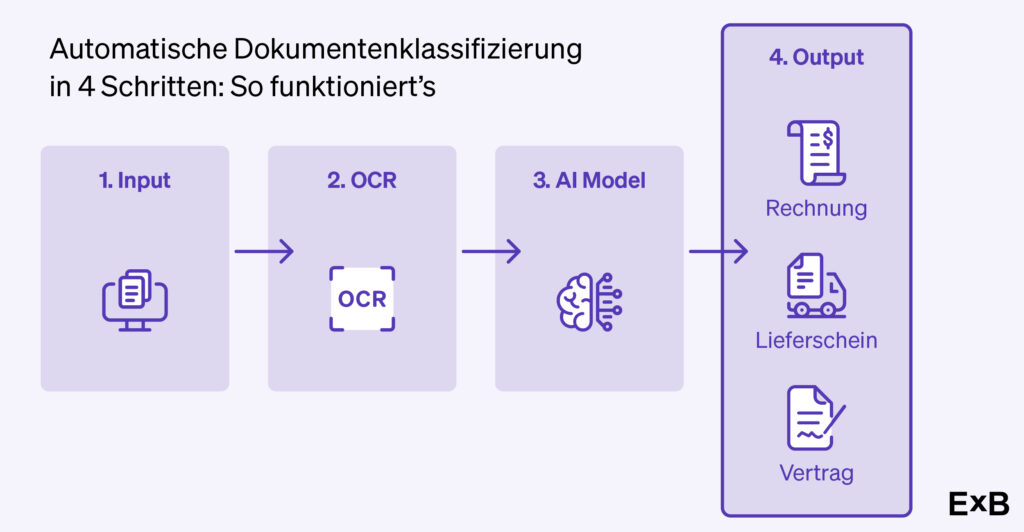
1. Input: Capture digital and scanned documents
The first step is to transfer the documents into the system.
These can be scanned PDFs, email attachments, or image files—such as invoices, delivery notes, contracts, or waybills. The origin, layout, or quality of the documents is irrelevant: all documents are recorded centrally and prepared for further processing.
2. OCR: Automatically read content
Optical character recognition (OCR) is then used.
OCR technology converts the documents into machine-readable text and recognizes:
- Text and numbers
- Tables and position data
- Layout elements such as headers and footers
This creates the basis for reliable automatic document classification—even for complex or confusing documents.
3. AI model: Classify documents intelligently
In the third step, an AI-supported classification model analyzes the recognized content.
This involves not only individual terms, but also an overall understanding of the document: its structure, typical content, and context are evaluated.
This enables the AI to automatically recognize the type of document, for example:
- Incoming invoice
- Delivery note
- Contract
- Freight or transport document
4. Output: Clear assignment for further processes
The result is a clear classification of the document.
Invoices, delivery notes, or contracts are automatically assigned correctly and can be transferred directly to downstream processes—such as ERP, DMS, or accounting systems.
This eliminates the need for manual pre-sorting and makes document processing significantly faster and more accurate.
In addition to OCR, machine learning, and deep learning, other components are used in productive setups:
- ICR
(handwriting) - Layout/structure analysis
(blocks, tables, headers/footers) - Feature engineering
from text, layout, and metadata (e.g., sender, file name) - Classic ML models
(e.g., SVM, random forest) on TF-IDF/N-grams - Transformer models
(e.g., BERT) for semantic text understanding - Hybrid/ensemble approaches
that combine image and text signals - Transfer and semi-supervised learning
to train effectively even with smaller amounts of data
Why is document classification important?
Companies are legally obliged to protect information in accordance with information security and GDPR requirements. Correct labeling—whether confidential, strictly confidential, or public—ensures that sensitive data does not fall into the wrong hands.
At the same time, automated data classification increases efficiency: documents are clearly labeled, processes are accelerated, and compliance risks are reduced.
The challenges without classification 📌
- Dokumente landen im falschen System oder gehen ganz verloren
- Prozesse verzögern sich, weil Informationen erst gesucht werden müssen
- Manuelle Fehler führen zu Compliance-Risiken oder Mehrarbeit
Why automated? 💡
Manuelle Regeln reichen nicht mehr aus, um die wachsende Vielfalt an Formaten und Inhalten zu bewältigen. Hier kommen ML und Deep Learning (DL) ins Spiel:
Diese Technologien erkennen Muster und Zusammenhänge in Dokumenten, die für Menschen nicht offensichtlich sind – zum Beispiel typische Formulierungen in Verträgen, das Layout von Rechnungen oder Absenderkennungen in Lieferscheinen.
What exactly does a model for machine learning or deep learning do? 🧠
- Es analysiert tausende Merkmale gleichzeitig – von Wörtern über Layouts bis hin zu Kontextbezügen.
- Es lernt aus Beispielen: Je mehr Daten es sieht, desto präziser wird die Klassifizierung.
- Es passt sich an: Auch wenn sich Dokumentenformate ändern oder neue Kategorien hinzukommen, bleibt das Modell flexibel.
Advantages of automatic document classification
Automated document classification saves time, reduces manual errors, and increases efficiency. Traditional approaches reach their limits, especially with unstructured documents such as emails or scanned forms. AI-supported systems, on the other hand, grow with each input through training and adapt flexibly to new document types—a decisive advantage for modern organizations.
Another success factor is Explainable AI, which explains how classification works – important for compliance and GDPR-compliant implementation.
The most important advantages at a glance:
✅ Reduction of errors:
As human intervention is reduced, the error rate also decreases.
✅ Reduction of processing time:
Automating repetitive tasks saves resources and time.
✅ Improved efficiency, reliability, and scalability:
Automation optimizes processes, controls reliability, and enables smooth scaling.
✅ Compliance:
Compliance with regulations and guidelines regarding data protection is improved.
for your logistics operations
Anna reads, understands, and processes documents like an experienced specialist.
She works directly with your team, automates document-driven tasks, and continuously improves your processes.
Start with a concrete use case and see the first results quickly.

Automatic document classification
in practice
In logistics in particular, seconds matter, not only on the road but also in document flow. Whether freight documents, delivery notes, or customs documents: relying on manual sorting here risks delays, errors, and unnecessary costs.
AI-based document classification—such as the ready-to-use models from ExB—provides an intelligent and scalable solution to these challenges. And not just in logistics.
Use cases and examples
Automatically recognize shipping documents and delivery notes 🚚
In transport logistics, bills of lading, CMRs, delivery notes, and shipping orders are part of everyday life, often as scans, PDFs, or email attachments.
ExB’s artificial intelligence (AI) automatically recognizes which document is present and forwards it to the appropriate system or the next process stage.
➡️ Result: No more incorrect filing, faster processing, compliance-compliant archiving.
Classify incoming invoices in real time 🧾
Logistics companies process invoices every day—from toll service providers, fuel card providers, or subcontractors. Automatic classification recognizes the format, type, and sender, even with very different templates.
➡️ Result: Automated comparison with receipts, less manual checking, faster posting.
Assign customer inquiries efficiently 📬
Whether it’s a transport request, damage report, or delivery information—many inquiries come in via email. AI automatically classifies these and forwards them directly to the right contact person.
➡️ Result: Response times are reduced and customer service is measurably relieved.
Process customs documents and export declarations correctly 🏷️
Precise customs and export documents are particularly important in international shipping. AI automatically recognizes customs documents such as export declarations, commercial invoices, and declarations of origin—even if they have inconsistent structures or are multilingual.
➡️ Result: Smooth customs clearance, fewer queries, and lower risk during customs inspections.
Outlook: Other industries 🏥
Automatic document classification also offers enormous potential in healthcare, industry, and commerce—for example, for the structured storage of findings, quotations, or test reports. ExB models can be customized for specific domains and are ready for immediate use without lengthy setup.
AI-based document classification
with ExB ✅
Automated document classification is revolutionizing document processing for companies in every industry. Using innovative, AI-powered technologies, documents can be sorted into relevant categories and classified accurately, efficiently, and cost-effectively. Classifying unstructured data in particular can be difficult and time-consuming.
For ExB, unstructured data is a breeze. Our platform enables ML-driven document classification: This is how our IDP platform transforms your entire business. Our solution is capable of recognizing even the slightest differences between individual document categories and classifying them accurately.
Classify
before it gets complicated
Whether it’s invoices, waybills, or customer inquiries, companies face the daily challenge of processing growing volumes of documents quickly, accurately, and efficiently. Those who still sort documents manually not only lose time but also potential.
Automatic document classification with AI delivers exactly the scalability, speed, and precision that modern processes need today—especially in logistics. Technologies such as OCR, machine learning, and deep learning transform raw data into structured information that can be processed immediately.
The good news:
Companies don’t have to develop their own models to do this. With ExB’s ready-to-use solution, classification processes can be automated quickly and securely – domain-specific, flexible, and future-proof.
FAQ
Everything you need to know about automatic document classification.
Automatic document classification is particularly worthwhile when dealing with large volumes of documents, varying formats, or manual pre-sorting—for example, in logistics, accounting, or purchasing.
Yes. Modern AI models do not rely on fixed templates and can recognize documents even with changing layouts, different senders, or poor scan quality.
Yes. Unlike traditional rule-based systems, AI-based solutions can reliably classify documents without time-consuming training or configuration.
It is the first crucial step for automated workflows. Only correctly classified documents can be reliably checked, forwarded, or processed by the system.